
The Clarity Journal — Week Theme: Process Design
If your business runs on processes nobody actually designed — workflows that got assembled under pressure, three years ago, and just stuck — this is for you. Below is a real framework for diagnosing what's broken, a 9-step process for fixing it, and a real example of what it looks like when it works. No new software required. Just a deliberate look at how work actually flows, and the discipline to redesign it.
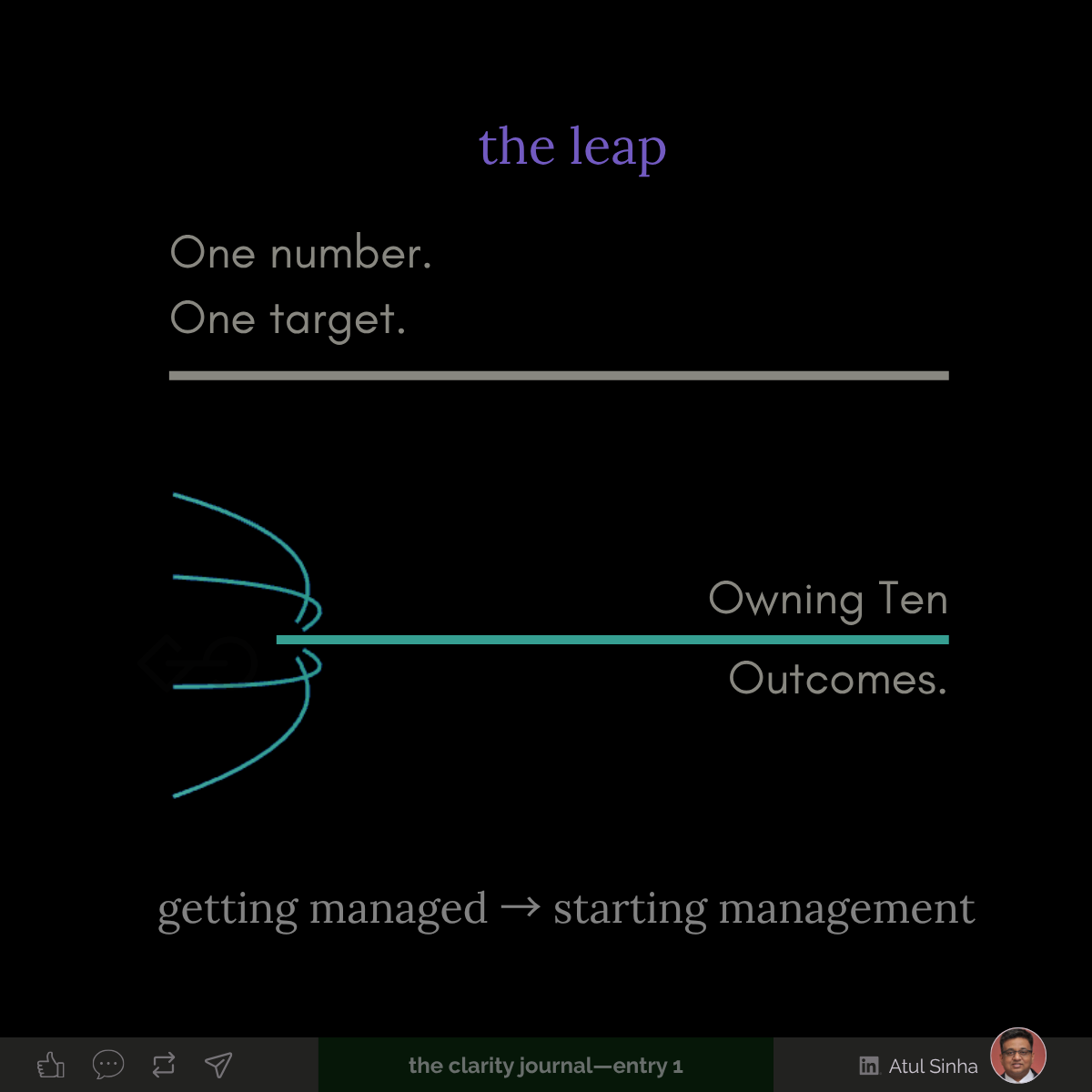
The leap that breaks new managers
My first job had a simple scoreboard: did I hit my number this month or not.
I was an individual contributor in sales. Every day had a clear shape — calls to make, a pipeline to push, a target to hit. I was good at it, mostly because I understood exactly what winning looked like.
Then I moved into project management on the delivery side of an IT-enabled services business. Different job, completely different planet.
Nobody hands you a number to hit anymore. Instead, you've got five workstreams, three of them quietly falling behind, a client who wants a status update you don't actually have, and a team that's looking at you to make a call you're not sure you're qualified to make yet.
I remember the exact week I realized sales had taught me how to chase one outcome — and delivery was demanding I hold ten moving parts at once, none of which I could fully control, all of which I was now accountable for.
I got it wrong more times than I got it right, early on. Missed dependencies. Said yes to timelines I should have pushed back on. Learned the hard way that "managing a project" and "managing the people on the project" are two completely different skills, and nobody teaches you both at the same time.
That jump — from owning your own number to owning everyone else's outcome — is one of the hardest, least talked-about transitions in a career. Most people either sink in it or come out the other side fundamentally different.
I came out different. It just took longer than I expected.
Most managers inherit chaos
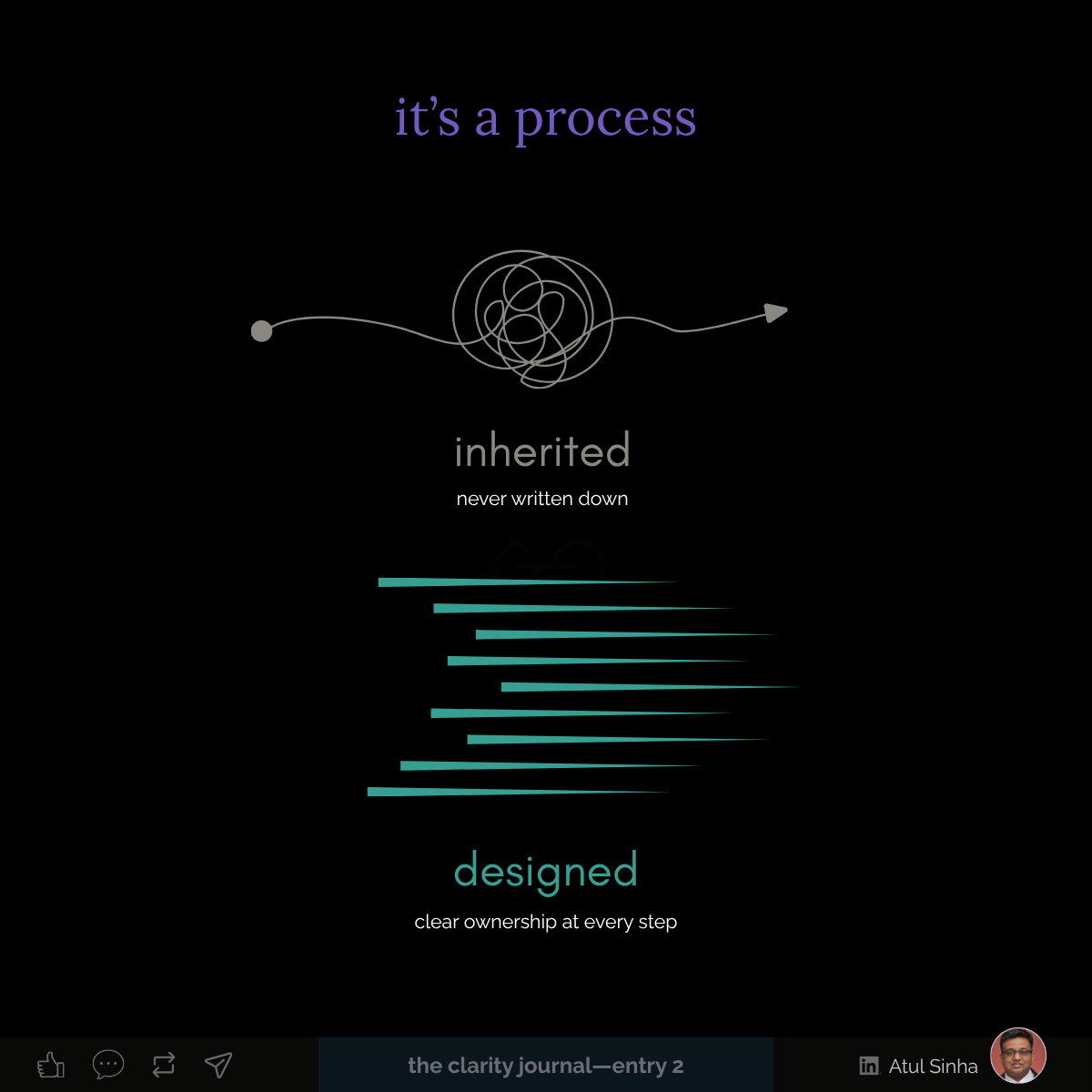
Most managers don't fail because they're disorganized. They fail because they inherited a process nobody ever actually designed.
Think about it. Somebody did a task one way under pressure, three years ago. It worked, barely. Then it became "how we do it" — never written down, never questioned, just passed forward like a rumor.
Then you become the manager. Suddenly you're accountable for a process you didn't build, can't fully explain, and definitely didn't choose.
That's not a discipline problem. That's not a "try harder" problem. It's an inheritance problem — and most managers spend years firefighting symptoms of a process that was never actually a process to begin with.
The fix isn't motivation. It's redesign.
The 9-step process redesign framework
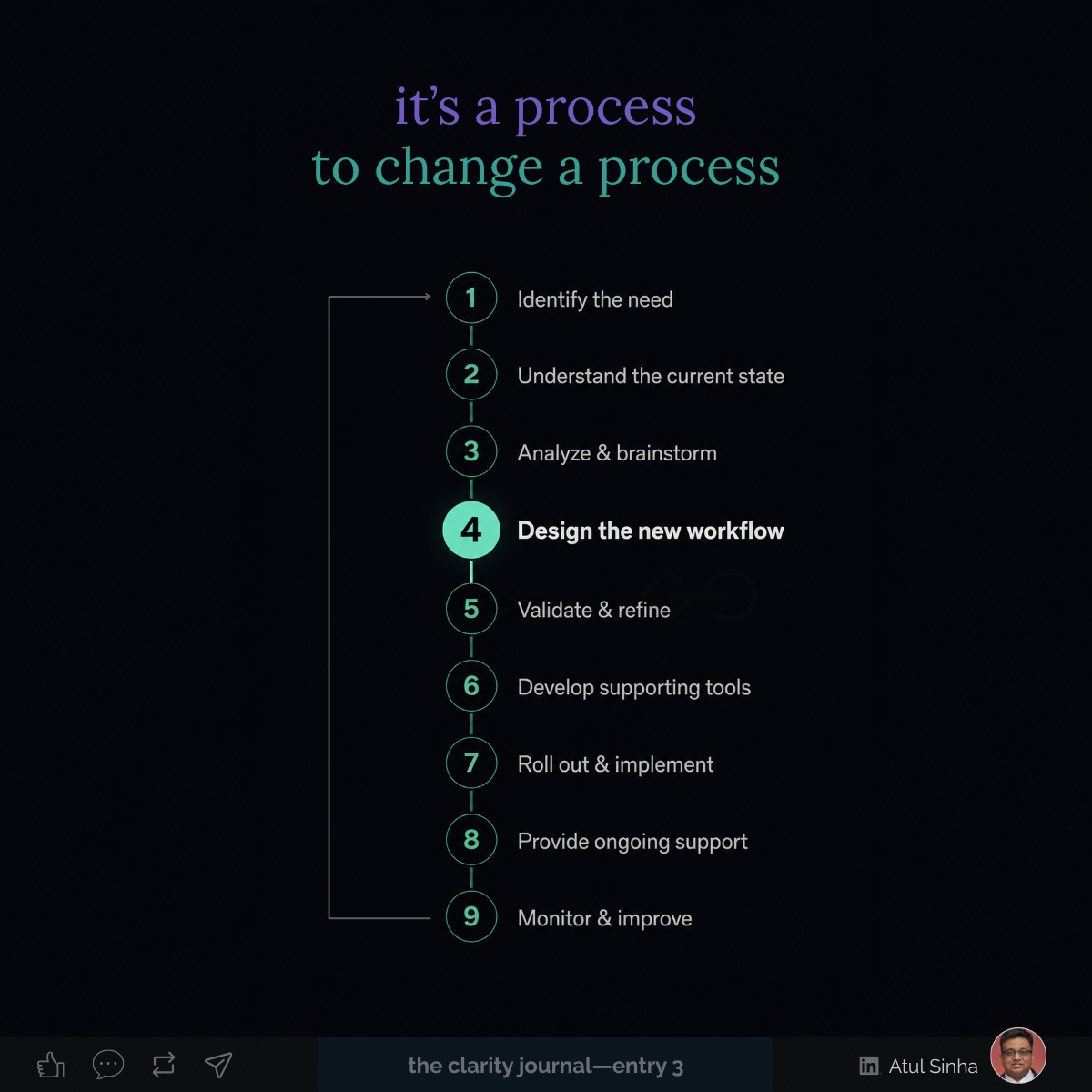
Here's the actual sequence I use to fix a broken process — the same one whether it's a 3-person team or a 300-person delivery org.
1. Identify the need — what's actually broken, specifically, not just "things feel messy"
2. Understand the current state — map how work really flows today, not how the org chart says it should
3. Analyze & brainstorm — find the real bottleneck, then generate more than one way to fix it
4. Design the new workflow — pick one path, make ownership unmistakable at every step
5. Validate & refine — test it on a small scale before rolling it out wide
6. Develop supporting tools — templates, checklists, trackers — whatever makes the new way the easy way
7. Roll out & implement — communicate the why, not just the what, or adoption stalls
8. Provide ongoing support — the first month after rollout is where most redesigns quietly die
9. Monitor & improve — a process you never revisit is already decaying
Most people stop at step 4. They redesign the workflow, announce it in a meeting, and assume it'll hold. It won't — not without steps 6 through 9.
The work that actually changes how a team operates happens after the big idea part, not during it.
A real example: fixing a 20-client weekly reporting process
A digital marketing agency I worked with ran weekly performance reports for 20 clients. Every single one was a fire drill.
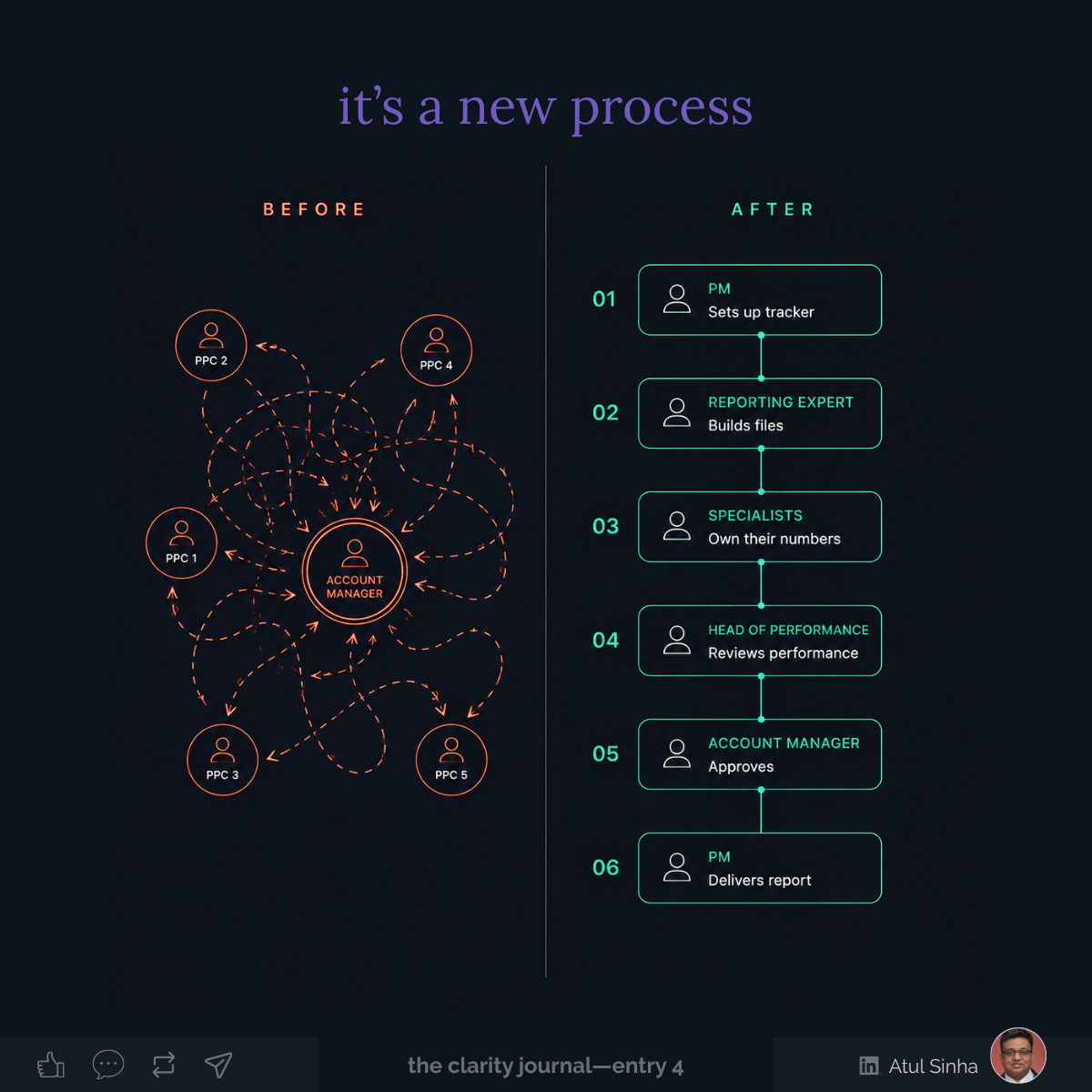
Numbers lived in a Slack channel, scattered across messages from 7 different PPC specialists. One person tried to assemble it all by hand. The account manager spent half their time just chasing people for "what's the latest number on this client?" — not analyzing anything, just hunting for data that already existed somewhere, in someone's head or half-finished spreadsheet.
By the time a report actually reached a client, nobody could say with confidence who owned which number, or why a campaign had moved the way it had. The account manager was constantly frustrated, and honestly, a little lost — improvising answers in client calls instead of having them ready.
We mapped the actual workflow first — who touches the report, in what order, and where it was breaking. Then we redesigned it: a PM owns the tracker, a reporting lead sets up the structure, each specialist owns and signs off on their own numbers, a clear review chain catches errors before a client ever sees them. Later, we moved the whole thing into a project management tool — same workflow, now with deadlines and ownership built in, repeatable every week without anyone having to remember the steps.
The result wasn't just faster reports. Time spent assembling them dropped by more than 90%, once the numbers lived in live dashboards instead of Slack threads. But the bigger shift was who was doing the thinking. Before, the account manager was winging strategy conversations because they didn't trust the data. After, specialists were the ones bringing strategy recommendations to the table — because they owned their numbers and actually understood them.
The report got better too. What used to be an inconsistent wall of numbers became a templated, client-ready deliverable every time. Client satisfaction went up — not because the campaigns suddenly performed better, but because the client could finally trust what they were being told, and why.
None of this needed new ad platforms or a bigger team. It needed someone to sit down and actually design how the work should flow — then build the system that makes that design hold, week after week.
A closing thought
very story above is really the same story, told from a different angle. Someone trusted me with a mess. I didn't have a clean answer on day one. I had to sit with the confusion long enough to actually see the shape of it, before I could fix anything.
I used to think that not knowing the answer immediately meant I wasn't good enough at this yet. Twenty-five years in, I've come around to the opposite view — the people who claim instant clarity on a messy problem usually haven't looked closely enough at it.
I'd rather be slow and right than fast and wrong. Most weeks, that's still the hardest discipline I practice.

Frequently asked questions
How long does it take to redesign a broken business process?
It depends on the complexity of the process and how many people touch it, but the 9-step framework above is built to move fast without skipping steps. A single-team process (like a weekly report) can typically go from diagnosis to a working redesign in a few weeks. Org-wide or cross-functional processes take longer - mainly because steps 6 through 9 (tools, rollout, support, monitoring) need real time to stick, not because the design itself is slow.
Do I need new software to fix a broken process?
No. The case study above didn't start with new software - it started with mapping the actual workflow and assigning clear ownership. Software (dashboards, PM tools) came later, as a way to support a process that had already been redesigned. Buying a tool before fixing the underlying process just digitizes the chaos.
How do I know if my business has a process problem, not a people problem?
A simple test: if you took a two-week vacation with no laptop, would your team know exactly what to do without texting you? Can a new hire find out who owns what without asking a person? Do you know your real numbers today, or only at month-end? If you hesitate on any of these, it's a process problem, not a people problem - your team is likely capable, but operating without a system that was ever actually designed.
What should I document so the process actually sticks?
Document 4 things: (1) the purpose and success metric, (2) the owner and roles (who does what), (3) the step-by-step workflow with inputs/outputs, and (4) the checks (how you catch errors and review performance). Keep it short and findable. A one-page playbook that people use beats a 30-page doc no one reads.
How do I get buy-in for a process change without endless meetings?
Use a small pilot. Pick one team, run the redesigned process for 2-4 weeks, and measure the before/after (cycle time, error rate, rework, or time saved). Share the results and the updated playbook. Real data beats opinions, and a working example removes fear because people can see what changes (and what doesn't).
What is the fastest first step to fix a broken process?
Start by writing down the current workflow exactly as it happens today (not how it should happen). Capture the trigger, the handoffs, the tools used, and the output. Once it's visible, pick 1 owner for the outcome and define a single success metric. You can improve a messy process quickly; you cannot fix a process you cannot see.
This is Week 1 of The Clarity Journal — a running record of patterns in business operations, process design, and the work of building systems that don't depend on any one person to hold them together.

Copyright GeekOps.io © 2025
Created with